Sunday, January 27, 2013

Report: Top al Qaeda leader killed
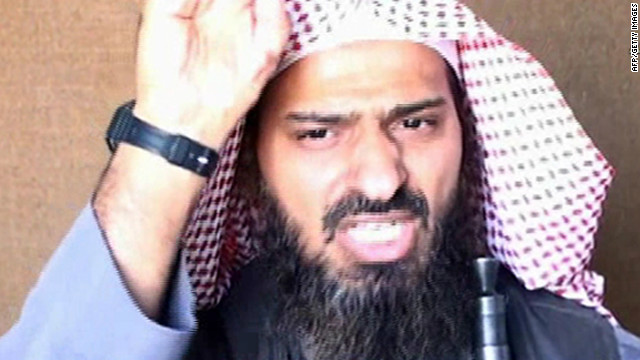
 
 
A screen shot of a video shows Al-Qaeda's Said al-Shihri on October 6, 2010.
 
Sanaa, Yemen (CNN) -- The deputy leader of al Qaeda in the Arabian Peninsula and one of the most wanted men in Saudi Arabia has been killed, a prominent jihadist announced Tuesday, though officials in the group's home base of Yemen said they had no evidence of his death.
Abu Sufyan al-Azdi, also known as Saeed al-Shahri, died "after a long journey in fighting the Zio-Crusader campaign," jihadist Abdulla bin Muhammad said on his Twitter account. The tweet was reported by SITE Intelligence Group, which monitors global terrorism.
It was not clear how al-Azdi died. SITE said media reports indicated he died of injuries incurred in a December drone strike.
The Arabic news network Al-Arabiya reported al-Azdi's death, citing his relatives.
 
Three senior Yemeni Defense Ministry officials told CNN the country has no evidence proving his death.
"We have no evidence to prove his death and our government continues to hunt down the leaderships of the terror network," one of the officials told CNN on condition of anonymity because he is not authorized to talk to media.
Read more: Amnesty details 'horrific abuses' in southern Yemen
He said more than 80 suspected al Qaeda militants have been killed since early December but that al-Azdi is still out there.
Al-Azdi has been reported dead in the past, the latest incident being in September when Yemen claimed he was killed in an air raid. An audio message released the next month supposedly featured al-Azdi saying he was still alive.
Al-Azdi spent six years in the U.S. military prison at Guantanamo Bay before being released in 2007. A Saudi national, he escaped Saudi Arabia to Yemen in 2008.
U.S. drone activity increased in 2012 targeting senior leaders of AQAP. Monday, a U.S.-led drone strike in Marib, an oil-rich province of Yemen east of the capital, targeted a vehicle carrying alleged al Qaeda operatives. The strike killed two militants, identified by the defense ministry as Ali Saleh Toaiman and Qassim Nasser Toaiman, and wounded five others.
Saturday, two U.S drone strikes killed eight people in Marib and another province, al-Baitha.
Yemeni President Abdu Rabu Mansour Hadi announced in October that Yemen would step up its military operations with the United States against al Qaeda operatives. In response, al Qaeda carried out a number of attacks on military and security commanders, personnel, patrols and installations, killing more than 60 people, according to Yemen's Interior Ministry.

Friday, January 25, 2013

Syria’s food shortages worsening, U.N. says


The military conflict triggered by a government crackdown on a nearly two-year-long uprising has shattered Syria’s once-proud agricultural self-sufficiency, with bread lines growing in some areas and meat and vegetable prices soaring.
“I was very saddened by the situation,” said Dominique Burgeon, director of emergencies at the FAO, after returning from a mission to Syria that ended this week. “The mission was struck by the plight of the Syrian people.”
In the first detailed international account of the agricultural situation in wartime Syria, the FAO said annual wheat and barley output fell from normal levels of 4.4 million to 5.5 million tons to less than 2.2 million tons in 2011-12. Production of staple items such as poultry, fruit and cooking oil plunged by up to 60 percent in some conflict zones, such as the central cities of Hama and Homs, and Daraa in the south.
Jihad Yazigi, editor of the Syria Report business newsletter, said the FAO report echoed other disturbing provisional agricultural data for last year, such as a decline of almost a third in the cotton crop and a 50 percent drop in sales at the state fertilizer company. A surge in fighting in the northeast of the country threatened to cause more suffering by affecting the wheat and barley crops concentrated there, he added.
“It’s a big issue for the population,” Yazigi said. “You will have more women forced to go into prostitution — and more children forced to beg.”
Some of the heaviest fighting of the war has taken place in Syria’s agricultural belt, including around the northern cities of Aleppo and Idlib. Rebel fighters control large areas of the countryside, meaning that food supply routes into mainly government-controlled city centers have been severely squeezed.
Most of the 10 million Syrians who live in rural areas — almost half the country’s peacetime population — have livelihoods linked to agriculture. Many now face severe difficulties in getting fuel and equipment, as well as the risk to their lives of working in the fields.
Although some observers said one cause of the uprising against Assad was a severe 2008 drought that decimated rural communities and drove people to poor urban suburbs, analysts said the latest war-related food shortages would not necessarily harm the government.
“The regime probably still has the ability to secure what it needs for its own constituency from the diminished supplies,” said David Butter, a Middle East economic specialist at Chatham House, a think tank in London “The economic and physical [distribution] infrastructure is probably still more in regime hands than in rebel hands.”
The war has brought an abrupt end to Syria’s two decades of near self-sufficiency in wheat, the country’s main carbohydrate staple, even if it has in the past been forced to tap the international market during drought years.
Grain traders said Syria faces huge difficulties in buttressing its supplies with large-scale imports. Although sanctions imposed by the United States and European Union do not officially target food or agricultural commodities, restrictions imposed on Syrian banks and trading companies mean that international institutions are reluctant to finance grain imports. The grain that does make it through tends to come piecemeal directly from neighboring countries, including Turkey and Iraq.
(Chasity M.)

Israel removes new Palestinian protest camp

The Israeli army has removed a Palestinian protest encampment of four tents and a building under construction near a village in the occupied West Bank, military sources said.
In addition to demolishing the structures near Beit Iksa, on the northwestern outskirts of Jerusalem, early on Monday "20 Palestinians at the site were evicted without incident," the sources said.
On Sunday night, the army issued "invasion removal orders" to the encampment, saying three of the tents and the building were on land owned by Israel, and the fourth tent was on the route of a planned separation barrier.
Activists on Friday set up the encampment to protest against Israel's intention to confiscate at least 124 acres of land near the village, naming the camp Bab al-Karama, Arabic for Gate of Dignity.
Bab al-Karama was inspired by a separate Palestinian protest camp of 24 tents set up on a disputed piece of land on the eastern outskirts of Jerusalem that was dismantled by police last week.
Activists had established that camp, which they dubbed Bab al-Shams, or Gate of the Sun in Arabic, in a bid to draw attention to Israeli plans to build in the area, known as E1.
(Chasity M.)
 

Deadly blasts rock Iraqi capital

Three blasts, including a suicide attack, have killed at least 17 people in and around the Iraqi capital, Baghdad, officials say.
The most deadly of Tuesday's explosions took place in Taji, 20km north of Baghdad, where a suicide bomber driving a car packed with explosives detonated his bomb near an army base, killing at least seven people and wounding 24.
Nasseer Rahman, a teacher, said he was sitting in a minibus waiting to pass the checkpoint when the bomb exploded about 120 metres away. He said dozens of cars were waiting in lines when the blast went off.
"As soon as the blast struck, we got off the minibus and ran to the site of the explosion," he said. "We saw several cars on fire and pools of blood, and everybody was screaming for help.''
Another car bomb exploded in a crowded market in the Shia neighbourhood of Shula, in the northwest of the capital, killing five people and wounding 13, police and hospital sources said.
"We received a call for us to head to the blast site. It was a car bomb. A woman was laying dead with a sack of groceries still beside her, and the wounded were screaming," said policeman Ghalib Ameer, whose patrol was called to Shula.
In Mahmudiya, a town 30km south of Baghdad, a car bomb attack near an army checkpoint killed five people, including two soldiers, and wounded 14 more.
Violence in Iraq has eased since the widespread sectarian carnage of 2006-2007, but Sunni armed groups still launch frequent attacks to reignite confrontation among the Shia majority, Sunni Muslims and ethnic Kurds.
Sunni protests
The latest attacks come amid rising ethnic and sectarian tension following the arrest last month of bodyguards assigned to the Sunni finance minister Rafia al-Issawi.
Thousands of Sunni protesters are camped out in western Anbar province in what is developing into a major challenge to Prime Minister Nouri al-Maliki, whose power-sharing government, split among Shias, Sunnis and Kurds, has been bogged down in infighting since the last US troops left a year ago.
The Shia prime minister is trying to ease protests that erupted a month ago after officials arrested members of the finance minister's security team on terrorism charges. Sunni leaders saw that move as a crackdown.
Since the fall of Saddam Hussein after the US-led invasion a decade ago, many Iraq Sunnis feel they have been marginalised by the Shia leadership and say Maliki is amassing power at their community's expense.
Maliki has appointed Shia Deputy Prime Minister Hussein al-Shahristani to investigate the protesters' demands.
Authorities said on Tuesday they had so far released more than 800 detainees unjustly held or whose sentences had ended.
But thousands of protesters, camped out on a highway in the Sunni heartland of Anbar, say they are determined to stay until their demands are met.
Sunni leaders want the modification of anti-terrorism laws and more control over a campaign against former members of Saddam's outlawed Baath party, both measures they believe unfairly target their minority community.
(Chasity M.)

Wednesday, January 23, 2013

Hillary Clinton to testify on Benghazi embassy attack

Hillary Clinton (file image) Mrs Clinton will be standing down in two weeks
US Secretary of State Hillary Clinton is due to testify to Congress over the deadly attack on a US mission in Benghazi, Libya, last year.
Mrs Clinton will face questions about security failures that led to the attack before the foreign relations committees of the Senate and the House.
She had been due to testify late last year but fell ill.
The US envoy to Libya Christopher Stevens and three other officials were killed in the attack on 11 September.
The ambassador died of smoke inhalation when he was trapped in the burning consulate building, after armed men had stormed the compound.
The assault triggered a major political row over who knew what and when. As a result, an independent panel - the Accountability Review Board - was charged with investigating the incident.
Democrats hold the majority in the Senate, where Mrs Clinton will be surrounded by former colleagues and the tone will likely be respectful, says the BBC's Washington correspondent, Kim Ghattas.
In the House, however, Mrs Clinton is expected to face much more heat.
The panel review did not blame her directly for any of the failures, but members of Congress will still want to know why she was not personally aware of requests for more security in a high-risk posting like Libya, our correspondent adds.
'Cover up'
On Tuesday, Republican Senator John McCain said he wanted to press Mrs Clinton on where she was on the night of the attack, and what warnings there had been about deteriorating security.
"It's been a cover up from the beginning," he told reporters.
 A scathing US inquiry blamed "grossly inadequate" security at the Benghazi mission
She will also face questions about how the administration of President Barack Obama handled the fallout.
Three State Department employees have been fired over the Benghazi attack, and recommendations the panel made in December are already being implemented.
Mrs Clinton, who is stepping down from her post in two weeks, has spent a month recuperating from a series of ailments in December.
She was treated in hospital for a blood clot near her brain, weeks after fainting and suffering a concussion in the subsequent fall.
Mr Obama appointed Mrs Clinton at the start of his first term in 2009. She is considered a strong candidate for the Democratic nomination for president should she run in 2016.
Outrage in Congress over the Benghazi incident and its aftermath has already led US ambassador to the UN, Susan Rice, to withdraw from the race to succeed Mrs Clinton.
Last November, Mrs Rice admitted releasing incorrect information after the Benghazi attack. She said there had been no attempt to mislead the public, but Republicans were unconvinced.
Mr Obama has since nominated Democratic Senator John Kerry - who is expected to be swiftly confirmed - as Mrs Clinton's replacement.
Mrs Clinton is due to testify for 90 minutes before the committees

Saudi activists say kingdom trying to silence them


By Ashley Fantz and Mohammed Jamjoom, CNN
updated 8:32 PM EST, Tue January 15, 2013


Saudi activist pushing limits for reform


(CNN) -- As he was falling asleep, the father of five turned to his wife and said he hopes it will all be worth it someday.
Maybe someday, Mohammed Al-Qahtani said, his daughter be able to walk somewhere without a male guardian. Maybe someday, she'll be able to drive a car without fear of arrest.
"Maybe I'm dreaming," Al-Qahtani said. "My newborn daughter, maybe one day she will vote for the prime minister in Saudi Arabia.
"Of course, there will be a price to be paid, and we are more than willing to pay that price."
The 46-year-old economics professor, who is also one of Saudi Arabia's most prominent human rights activists, has been on trial for several months in Riyadh. He faces nine charges, including breaking allegiance to the Saudi king, describing Saudi Arabia as a police state and turning people and international bodies against the kingdom.
His co-defendant, Abdullah Al-Hamid, faces similar charges, including spreading chaos, questioning the authority of official clerics and undermining public order. If convicted, both could go to prison for several years.
Al-Qahtani calls the accusations against them nonsense and says he knows why he and Al-Hamid were really put on trial. He said he and Al-Hamid have stoked the ire of the kingdom for running an activist group that is trying to expose human rights violations in the country.
Mohammed Al-Qahtani said he's on trial because his group is trying to expose human rights violations in Saudi Arabia.
"We have a number of cases where people are thrown in prison arbitrarily, torture, forced disappearances. ... Whatever rights abuses (you could think of), you could find in Saudi Arabia," Al-Qahtani said.
According to rights groups, Saudi authorities have been increasingly targeting activists through the courts and other arbitrary means such as travel bans.
"This has been a systematic approach by the authorities in Saudi Arabia -- namely, the targeting and harassing of activists across the country," said Tamara Al-Rifai, spokeswoman for Human Rights Watch's Middle East and North Africa division.
Al-Rifai told CNN that accusations against activists generally include "instigating chaos, gathering illegally, harming the reputation, talking to foreigners, talking to the media, etc."
She said there is no clear criminal law in Saudi Arabia and that people "are being arbitrarily arrested and detained for exercising rights that are stipulated by all international human rights laws, but also the Arab Charter of Human Rights to which Saudi Arabia has adhered."
In June, Amnesty International issued a statement calling Al-Qahtani's trial "just one of a troubling string of court cases aimed at silencing the kingdom's human rights activists."
"The case against him should be thrown out of court as it appears to be based solely on his legitimate work to defend human rights in Saudi Arabia and his sharp criticism of the authorities," said Philip Luther, director of Amnesty International's Middle East and North Africa Program.
When asked about the case and about accusations that Saudi Arabia is cracking down on dissent, Saudi officials have been reluctant to comment.
"At the Interior Ministry, our area of responsibility is security," said Maj. Gen. Mansour Al-Turki, spokesman for the Saudi Interior Ministry. "My understanding is that these cases are being looked at by the courts now. Nobody will comment on cases being looked at by the courts."
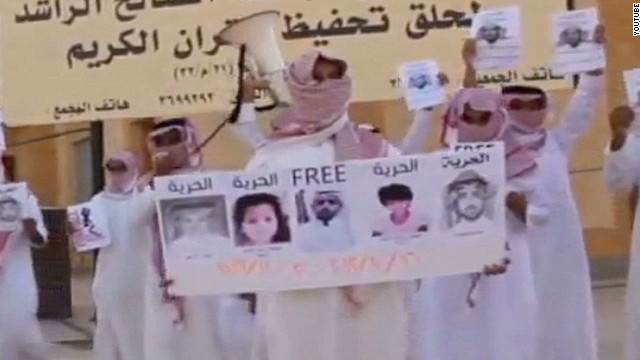
In Saudi Arabia, a deeply conservative kingdom and an absolute monarchy, protests are prohibited. Still, activists say, small gatherings are becoming more frequent -- demonstrations by both men and women demanding the release of jailed relatives.
The latest high-profile incident happened early this month. According to rights groups, Saudi security forces arrested a group of women in the town of Buraida who were protesting over family members allegedly held for years as political prisoners. The women said the relatives had been detained without charges on suspicion of terrorism.

Thursday, January 3, 2013

Aleppo airport closes due to 'rebel attacks'